Carpet Padding Guide: Types, Thickness, and Why It Matters
Carpet padding costs $0.30–$1.00/sq ft but affects comfort, durability, and warranty validity. Here's how to choose the right type and thickness for any room.
Quick Answer
Carpet padding costs $0.30–$1.00/sq ft but affects comfort, durability, and warranty validity. Here's how to choose the right type and thickness for any room.
The Part Most Buyers Skip
Carpet gets all the attention - fiber type, pile style, color, texture. Padding is an afterthought. That's backwards. The pad under your carpet affects how it feels, how long it lasts, and whether your carpet warranty stays valid.
A $2/sq ft carpet on excellent 8 lb rebond padding outperforms a $4/sq ft carpet on thin builder-grade pad. And a carpet installed without proper padding can void the manufacturer warranty entirely.
Before you get to pad selection, figure out your total carpet budget so you know how much room you have to upgrade the pad without blowing your overall number.
The Four Main Types of Carpet Padding
Rebond Foam
Rebond is the most common residential carpet pad - it accounts for roughly 85% of all carpet padding installed in U.S. homes. It's made from recycled polyurethane foam (the same foam used in furniture cushions), bonded together into a dense, multi-colored slab.
It comes in a range of densities (measured in pounds per cubic foot):
- 6 lb density: Builder grade. Meets minimum requirements. Compresses quickly under furniture and traffic.
- 8 lb density: Standard upgrade. The right choice for most residential applications.
- 10 lb density: High-traffic or commercial-adjacent use. Overkill for bedrooms, worthwhile for family rooms and stairs.
Cost: $0.30–$0.65/sq ft depending on density.
Rebond is not suitable for all situations. It doesn't perform well in high-moisture environments (basements) because the foam can absorb and trap moisture over time.
Memory Foam Padding
Memory foam padding offers a noticeably softer underfoot feel - similar to the effect of high-face-weight carpet but at the pad level. It responds to pressure and body heat, which some people find extremely comfortable.
The downside: memory foam compresses more than rebond under continuous load, which means heavy furniture can leave permanent indentations. It costs $0.65–$1.00/sq ft and offers less support for high-traffic areas.
Best use: master bedrooms and low-traffic areas where comfort is the priority.
Fiber Pad (Felt)
Fiber pads are made from compressed natural or synthetic fibers - often recycled textile scraps. They're firmer and denser than foam options, which makes them an excellent choice for Berber carpet. Berber's looped construction can snag on foam padding if the adhesion isn't perfect; fiber pad provides a stable, flat surface.
Cost: $0.50–$0.80/sq ft.
Fiber pads are also more moisture-resistant than rebond foam, making them a decent choice for finished basements with good vapor barriers. They don't provide the cushiony feel of foam but offer excellent support and longevity.
Flat Rubber Padding
Waffle-patterned rubber pads were once common but have largely been replaced by rebond. Flat rubber padding (as opposed to waffle rubber) is still used in commercial applications and for area rugs. It's extremely durable, non-compressible, and moisture-resistant.
For residential wall-to-wall carpet, flat rubber is more expensive ($0.80–$1.20/sq ft) and doesn't offer the same underfoot comfort as foam options. It sees limited use in high-end commercial spaces, gyms, and specialty applications.
Thickness: 7/16 vs 1/2 Inch - Does It Matter?
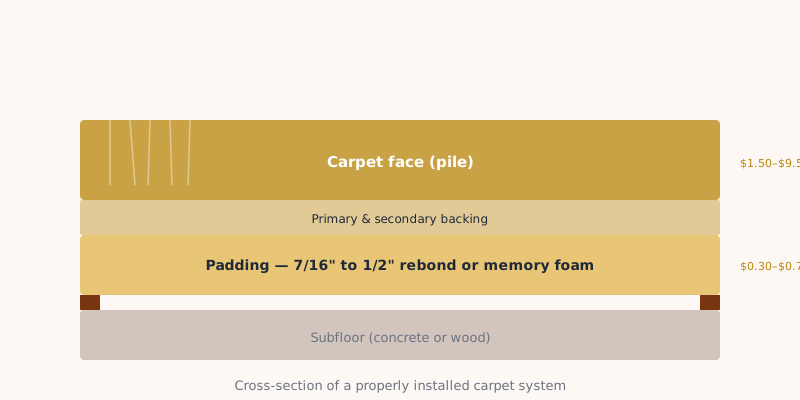
Standard residential padding comes in 7/16 inch (roughly 11mm) and 1/2 inch (12.7mm) thicknesses. The difference sounds negligible. In practice:
7/16 inch at 8 lb density is the industry standard recommendation for most residential carpets. It meets the specifications required by most carpet warranties without over-compressing.
1/2 inch provides slightly more cushioning but can cause problems for loop-pile carpets (Berber). The extra give creates micro-buckling at the loop level, accelerating wear. For cut-pile carpet (saxony, plush, frieze), 1/2 inch is fine. For Berber and most commercial carpets, stick to 7/16 inch or less.
Going thicker than 1/2 inch - some pads go to 3/4 inch - is almost never recommended for residential wall-to-wall carpet. The extra thickness creates too much flex, which stresses carpet seams and causes them to separate prematurely.
Density vs. Thickness: What Actually Matters More
Density is the more important specification. A thin pad with high density outperforms a thick pad with low density for durability.
The reason: density determines how much the pad compresses under load. A low-density pad compresses fully under a couch leg or in a high-traffic hallway. Once bottomed out, the carpet above gets no support and the backing wears against the subfloor.
Minimum recommended specs for residential carpet:
- Bedrooms: 6 lb density, 7/16 inch thickness
- Living rooms and hallways: 8 lb density, 7/16 inch thickness
- Stairs: 40 oz face weight carpet + 8 lb density pad (or use no pad with certain stair installations; check with your installer)
Warranty Implications
Most major carpet manufacturers (Shaw, Mohawk, Beaulieu, Karastan) specify minimum pad requirements in their warranties. Installing the wrong pad - even if the installer recommended it - can void your warranty claim if the carpet fails prematurely.
Common warranty pad requirements:
- Minimum 6 lb density rebond (most brands require 8 lb for full warranty coverage)
- Maximum 7/16 inch thickness for loop-pile carpet
- No waffle rubber pads (many brands explicitly exclude them)
Always check the carpet manufacturer's warranty document before selecting a pad. If your installer is bundling a pad without specifying the density, ask. "Standard pad" is not an acceptable answer when a manufacturer requires a specific density rating.
Moisture and Basement Considerations
Standard rebond foam is not a vapor barrier. In damp basements, moisture passes through it unchecked, causing mold, mildew, and accelerated carpet degradation.
For basement installations:
- Use a moisture-barrier pad (some rebond products include a film backing)
- Or use a fiber pad on a sealed concrete subfloor
- Avoid memory foam padding entirely in basements
A proper moisture-resistant pad in a basement costs $0.50–$0.80/sq ft but can add years to carpet life in a space that's even slightly damp.
Worked Example: Comparing Pad Options for a 300 Sq Ft Family Room
Base carpet: mid-range nylon at $3/sq ft material, $1.50/sq ft labor. Room: 300 sq ft.
Option A: Builder-grade 6 lb rebond at $0.30/sq ft
- Pad cost: $90
- Total installed (carpet + pad + labor): $1,440
- Expected pad lifespan: 8–10 years
Option B: Upgraded 8 lb rebond at $0.55/sq ft
- Pad cost: $165
- Total installed: $1,515
- Expected pad lifespan: 12–15 years (matches carpet lifespan)
Option C: Memory foam at $0.85/sq ft
- Pad cost: $255
- Total installed: $1,605
- Best feel underfoot, but may compress under furniture within 5–7 years
The $75 difference between builder-grade and upgraded rebond is the best value upgrade in carpet installation. Our carpet installation cost estimator lets you add your pad cost separately so you can see exactly how it changes the total.
Our team consistently recommends upgrading to 8 lb rebond as the highest-value single change in any carpet project. It costs less than one soda per square yard more than builder grade.
For the full picture on what goes into carpet pricing, see our carpet cost breakdown guide. For spec recommendations by carpet type, check the carpet grade guide. And before installation day, review carpet installation mistakes - several of the most common ones involve pad selection errors.